
AI Strategy
Microsoft's AI Chief Says 18 Months. Here's What He Gets Wrong.
Mustafa Suleyman says all white-collar jobs will be automated in 18 months. He's probably directiona...
The news isn't about what happens to OpenClaw. It's about what happens to the boundary between human work and agent work — and why frontier operators see opportunity where others see uncertainty.

When Reuters broke the news that OpenClaw creator Steinberger was joining OpenAI, the reaction split cleanly in two.
One group panicked: What happens to the tool I depend on?
The other group — the ones we'd call frontier operators — asked a different question entirely: Where does the boundary move next, and how do I position for it?
This post is for the second group. And if you're in the first group, we're going to move you to the second by the time you're done reading.
OpenClaw is open source. It's not a SaaS product that disappears when the founder leaves. The codebase, the community, and the documentation all continue. Steinberger's move to OpenAI likely accelerates development — someone who deeply understands agent orchestration is now inside the most capable model provider on the planet.
But that's not actually the interesting story here.
Every business running AI agents — whether they know it or not — is managing a boundary. On one side: things humans do. On the other: things agents handle. The art of running AI well isn't about the technology. It's about knowing exactly where that boundary sits right now and having calibrated intuition about where it's heading.
We call this boundary sensing, and it's the single most important skill in frontier operations.
When the creator of your agent orchestration platform joins the company building the most powerful models, the boundary doesn't disappear. It moves. And it moves faster than your planning cycle probably assumes.
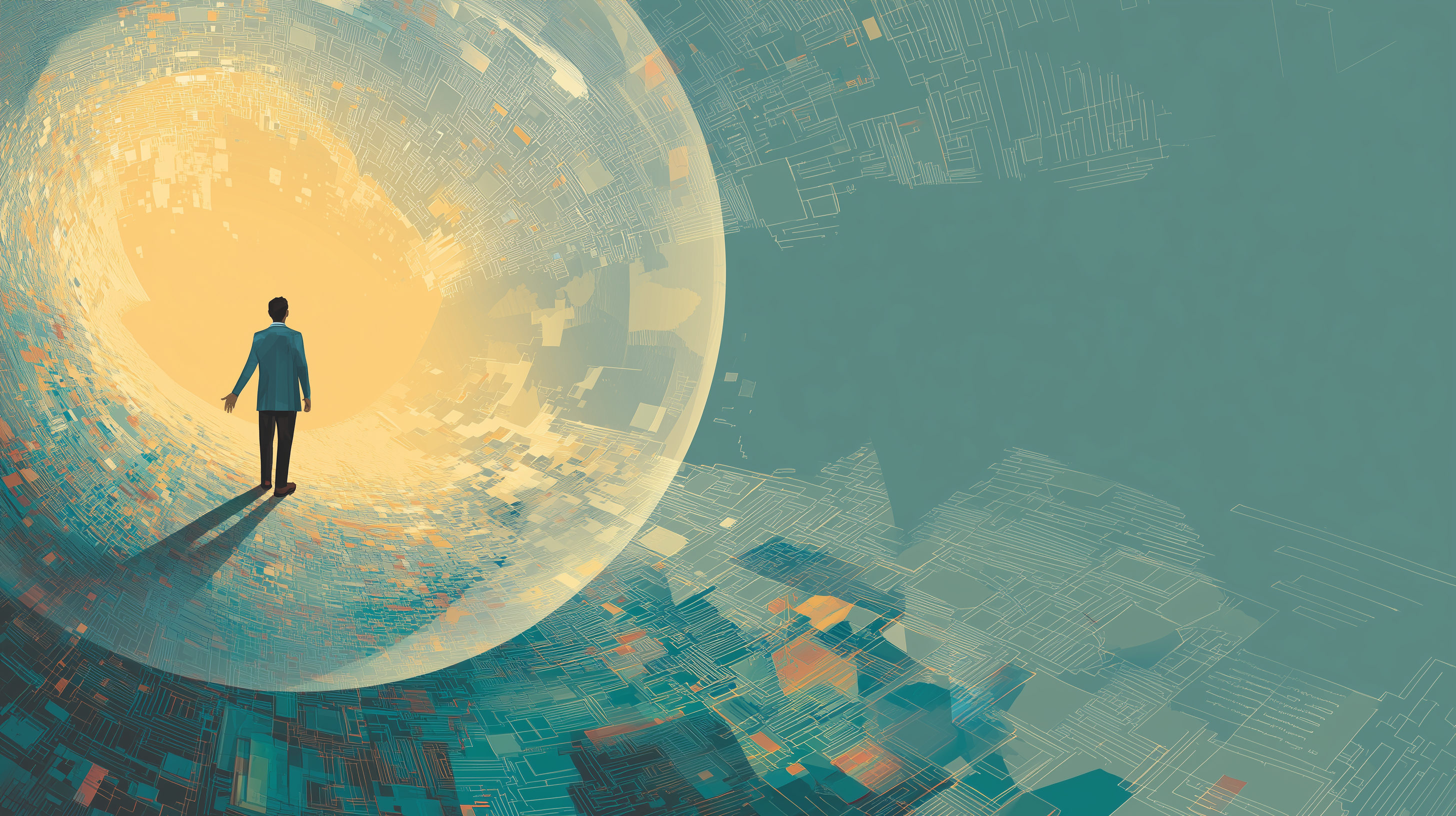
Here's the mental model that changes everything: think of AI capability as an expanding bubble.
Most people look at the bubble and see it swallowing work. The bubble is getting bigger, so there's less for humans to do. This is wrong — and it's wrong in an important, non-obvious way.
The surface area of a bubble grows as the bubble expands. That surface — the boundary between what's inside (agent work) and what's outside (human work) — is where the interesting jobs live. More capability means more boundary. More boundary means more places where human judgment, context, and intent need to interface with agent execution.
The bubble doesn't eliminate human work. It restructures it. The volume of routine work shrinks. The surface area of boundary work — supervision, intent-setting, quality verification, exception handling — grows.
This is why knowing where your business sits on the AI spectrum matters so much. You're not trying to get inside the bubble. You're trying to work the surface intelligently.
If the boundary is where the action is, then seam design is how you build for it.
A seam is any point where work transitions between human and agent. Every business running agents has seams — most just haven't designed them intentionally.
Bad seams look like this: an agent handles customer inquiries, and when it can't answer, it... just stops. Or makes something up. Or escalates with zero context. The human picks up a mess with no idea what happened.
Good seams look like this: the agent handles the inquiry, recognizes the boundary of its competence, packages what it knows and what it tried, and hands off cleanly. The human picks up with full context and a clear decision to make.
This is what we mean by production-ready. Not "the agent never fails" — that's fantasy. Production-ready means the agent fails legibly. You can see what happened, why, and what needs human attention.
When capability shifts — like Steinberger joining OpenAI — seams need recalibration. Some handoffs that required human intervention last month might not need it next month. Some that seemed fine might need more human attention because the agent is now capable enough to attempt harder things and fail in new ways.
Here's the real risk nobody's talking about, and it has nothing to do with platform stability.
Klarna fired 700 people and replaced them with AI agents. The agents optimized the metrics they were given. Customer satisfaction scores held — for a while. But the agents weren't encoding Klarna's intent. They were optimizing numbers.
This is the difference between metric optimization and intent engineering.
Metric optimization: the agent hits your KPIs. Intent engineering: the agent understands what your business actually wants and makes judgment calls that serve that purpose — even when the metrics don't capture it.
A customer service agent can resolve tickets fast (metric) while systematically eroding trust with long-term customers who need patience (intent). The numbers look great right up until they don't.
As models get more capable — and Steinberger at OpenAI suggests they will, faster — this gap between metric and intent becomes the most dangerous failure mode. More capable agents that optimize the wrong thing cause more damage, not less.
The question isn't "will my agent still work?" It's "does my agent know what my business actually wants?"
This is why soul documents exist. They're not personality prompts. They're intent infrastructure — the encoding of organizational purpose into agent behavior.
Agents don't just "make mistakes." They fail in specific, textured ways that change as capabilities change.
A model that couldn't write code failed by refusing. A model that can write code fails by writing plausible-looking code with subtle bugs. The failure mode shifted from obvious to insidious. Same pattern applies to every capability gain.
Failure model maintenance means understanding the specific texture of how your agents fail right now and updating that understanding as capabilities shift. When Steinberger's work starts influencing OpenAI's models, failure textures will change. Agents will attempt things they previously couldn't. Some of those attempts will succeed. Some will fail in ways you've never seen before.
This is why designing for prompt injection and running evals aren't optional — they're your early warning system for new failure textures.
Not everything moves with the boundary. Some things are structurally protected — they remain human work regardless of how capable agents become.
Strategic intent. Deciding what your business is and what it wants is irreducibly human. You can use agents to explore options, but the choosing is yours.
Relationship depth. Your clients hire you, not your agent. The agent handles the work; you hold the relationship. This doesn't change with better models — it becomes more valuable as automated interactions become commoditized.
Accountability. When something goes wrong, a human answers for it. No model advancement changes this. Running multiple agents means running multiple accountability surfaces, and those are always human.
Taste. Knowing what good looks like for your business, your clients, your market. Agents can generate options. Taste selects.
These aren't sentimental claims about human specialness. They're structural observations about what types of problems resist automation. The boundary moves, but these remain on the human side.
Here's what a reasonable operator should expect:
More capable base models. Steinberger's agent orchestration expertise combined with OpenAI's model capabilities will likely produce models that are better at multi-step reasoning, tool use, and maintaining context across long workflows.
Better agent primitives. Expect improvements in the infrastructure layer — how agents maintain state, handle handoffs, and recover from failures. This is Steinberger's specific expertise.
The boundary moves inward. Tasks that currently require human oversight will become reliably automatable. This is good news — it frees human attention for higher-value work.
New failure modes emerge. More capable agents will attempt more ambitious tasks and fail in novel ways. Your monitoring and eval infrastructure matters more, not less.
Attention calibration becomes critical. With more capable agents, the question of where to spend scarce human attention becomes the highest-value strategic decision. Getting this wrong — over-supervising commodity tasks while under-supervising high-stakes ones — is the most common and most expensive mistake.
Is OpenClaw going away? No. It's open source. The community and codebase continue independently. If anything, having the creator inside OpenAI increases the chance of deeper integration with the most capable models.
Should I be worried about my agent setup? You should be strategic about it. Review your seams — where does work transition between human and agent? Are those transitions clean and intentional? That's more productive than worrying.
What should I do right now? Three things. First, audit your seams: identify every point where work transitions between human and agent. Second, check your intent: is your agent optimizing metrics or actually encoding what your business wants? Third, update your failure model: understand how your agents fail today so you can spot when failure textures change.
Does more capable AI mean I need fewer people? It means you need people doing different things. The bubble expands, the surface area grows. The nature of human work shifts from execution to boundary management — supervision, intent-setting, quality verification, exception handling. These are higher-value roles, not fewer roles.
How do I know if my agent infrastructure is ready for faster capability shifts? Ask yourself: if the model powering my agents got significantly better tomorrow, would my setup automatically benefit — or would it break in new ways? If your soul documents are read-only, your evals are running, and your seams are designed intentionally, you're positioned well.
Steinberger joining OpenAI isn't a threat to businesses running OpenClaw. It's a signal about the speed of boundary movement. The operators who treat this as useful intelligence — and adjust their seam design, intent engineering, and failure models accordingly — will outperform the ones who either panic or ignore it.
The boundary between human work and agent work is moving. It's always been moving. It just moved faster.
The question is whether you're sensing that boundary or guessing at it.
Associates AI helps small businesses design, deploy, and manage AI agent systems that actually work in production. If you want help thinking through where your boundary sits — and how to build for where it's heading — let's talk.
Written by
Founder, Associates AI
Mike is a self-taught technologist who has spent his career proving that unconventional thinking produces the most powerful solutions. He built Associates AI on the belief that every business — regardless of size — deserves AI that actually works for them: custom-built, fully managed, and getting smarter over time. When he's not building agent systems, he's finding the outside-of-the-box answer to problems that have existed for generations.
More from the blog
Mustafa Suleyman says all white-collar jobs will be automated in 18 months. He's probably directiona...
Intuit and Anthropic announced a partnership on February 24th that will let mid-market businesses bu...

Business Insider's solopreneur story is real. So is the METR study showing developers getting 19% sl...
Want to go deeper?
Get started today. Hire your first Teammate in minutes and put it to work on what you're reading about.
Get Started